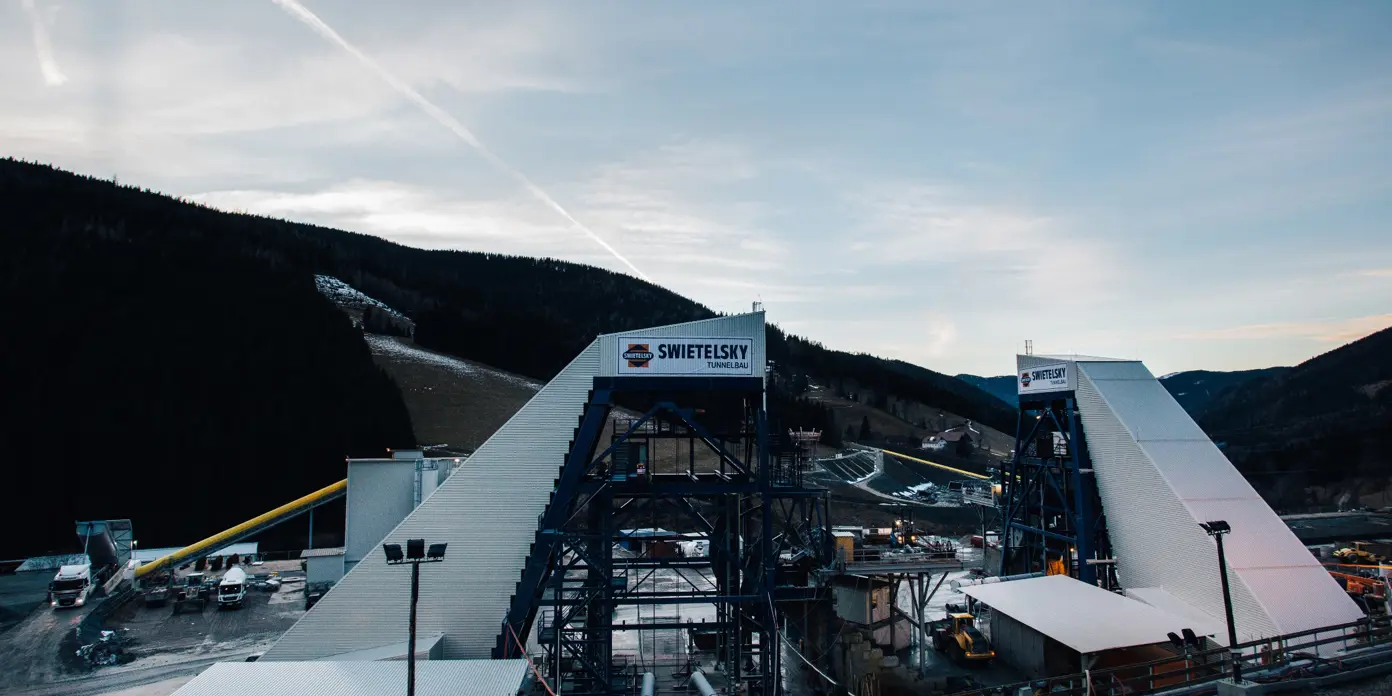
160222 SBT Schachtarbeiten (5)

The Semmering Base Tunnel is a project of superlatives for mobility and climate protection. Equally gigantic are the technical challenges involved in building it.

170622 Semmering SBT2.1 Begehung NHS (24)

The Semmering Base Tunnel (SBT) is one of Europe’s most important infrastructure projects and part of Austria’s new Southern Railway— a key axis of the trans-European link from the Baltic Sea to the Adriatic. The 27.3-kilometre tunnel connects Lower Austria and Styria and is intended to make passenger travel more comfortable while making rail freight significantly more powerful and energy-efficient. From around 2028, passengers are expected to be able to travel from Vienna to Graz in under two hours; freight traffic will also be routed via the new line. This will make rail on the north–south axis more competitive with cars and trucks. However, the project—running since 2012 and divided into three construction phases—is a major challenge due to difficult geology and high complexity, and it involves several construction consortia.

180216 FT01 S01 Transport Bohrkopf TVM Über S01 (40)

Complex vertical logistics

A special feature is access to the tunnel system via two vertical shafts around 400 metres deep. At the bottom of the shaft, a large cavern was excavated, which will later serve as an underground emergency stop. SWIETELSKY was responsible for construction as well as the supply, installation, and operation of the shaft facilities. More than five million tonnes of excavated material are hoisted out via the shafts, and equipment and construction materials are transported in. The facilities are designed so that even the heaviest TBM components—up to 109 tonnes—can be moved in the hoisting cage. The installed power is 10,100 kilowatts—roughly comparable to the demand of about 1,000 single-family homes.

180215 S01 Transport Hauptantrieb TBM Über S01 (95)

Tunnel boring machines weighing 3,500 tonnes

Most of the SBT and all access routes are being built using excavator-and-blast methods. Up to mid-2018, excavation was largely conventional; after that, two tunnel boring machines were deployed, each 120 metres long and 1,750 tonnes heavy (one per tube). Since then, they have been driving more than eight kilometres from Fröschnitzgraben towards Gloggnitz. TBMs are used here only where geology and cost-effectiveness allow—on the SBT, this is about one third of the route. The machines were built in France, delivered in individual parts, and assembled 400 metres underground.

180216 FT01 S01 Transport Bohrkopf TVM Über S01 (89)

Production of lining segments

A total of around 50,000 segments (“tubbings”) are required for TBM excavation—precast concrete elements weighing about seven tonnes each. Six segments form one ring, which lines two metres of tunnel; the segments are installed immediately after excavation for support. They are produced by SWIETELSKY in Neunkirchen: 49,200 segments are being manufactured there for 8.2 kilometres. The plant operates with 48 precision moulds, a carousel system, and automated handling; a high production rate is required so the drive does not stop (about one segment every twelve minutes), with a daily output of up to 120 segments. After reinforcement, concreting, smoothing, and curing, the elements are first stored temporarily (including an open storage yard with capacity for about 6,600 units) and then transported by special vehicles to the installation site. Each vehicle delivers one ring (six segments)—enough for two metres of tunnel. Different geological conditions require different concrete mixes and ring types; the automated processes improve quality, reduce waste, and increase plant availability.