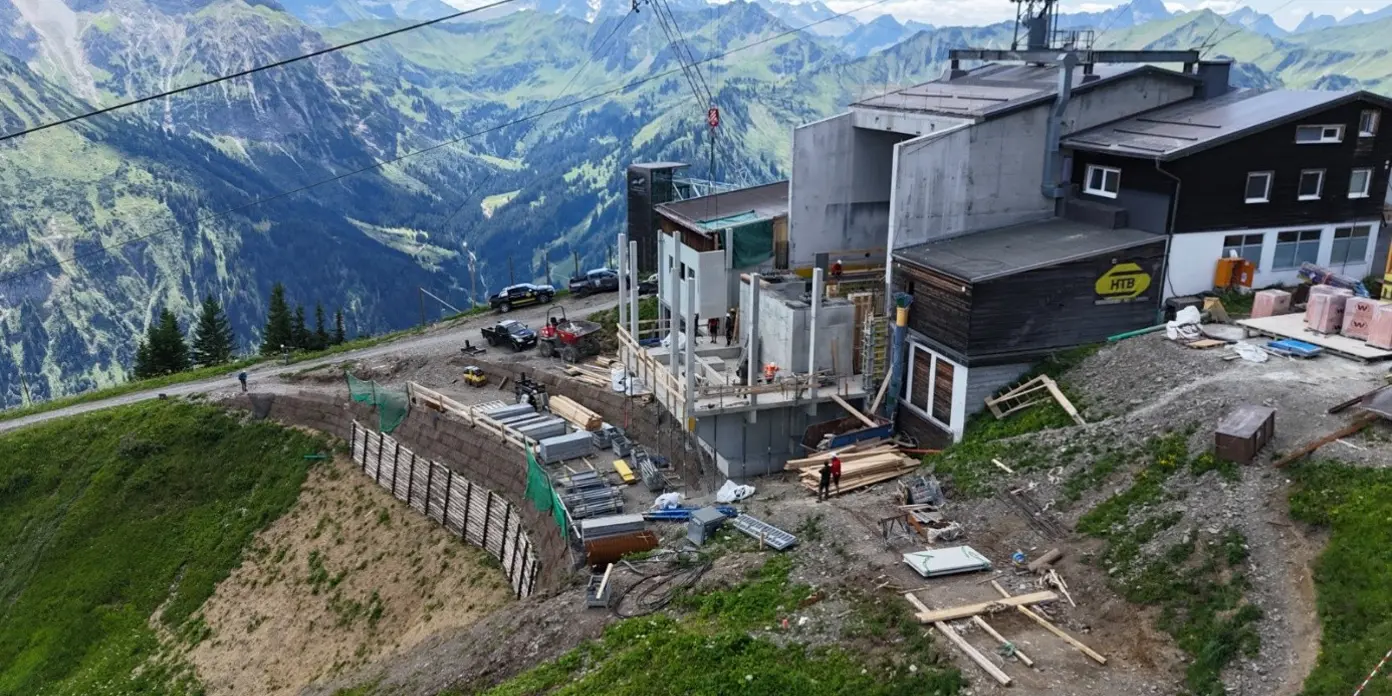
A NEW CABLE CAR IS BEING BUILT ON THE WALMENDINGERHORN IN THE KLEINWALSERTAL AMID CHALLENGING ALPINE CONDITIONS. THE NEW CABLE CAR COVERS AN ELEVATION DIFFERENCE OF APPROXIMATELY 739 METERS OVER AN INCLINED TRACK LENGTH OF ABOUT 1,940 METERS, CREATING A FUTURE-PROOF CONNECTION BETWEEN MITTELBERG AND THE WALMENDINGERHORN.
Two aspects are central to the project: modern cable car technology is to be implemented along the existing route and, for the most part, integrated directly into the existing infrastructure. As the general contractor, HTB-Baugesellschaft m.b.H. is responsible for the submission and detailed design plans, as well as the construction of all building and civil engineering works. Garaventa AG serves as the cable car manufacturer.
State-of-the-art engineering and performance data
Over a sloped route length of approximately 1,940 meters, the new reversible cable car overcomes an elevation difference of about 739 meters. Two cabins each accommodate 65 passengers, with one of the two tracks additionally designed for freight transport. With a planned capacity of approximately 638 passengers per hour in each direction, the cable car will ensure safe and efficient transportation in the future.
Precise Preparation and a Tight Construction Schedule
The project is characterized by an intensive planning phase for its construction. Initial preliminary planning and variant studies will begin as early as 2020, followed by detailed calculations, surveys, and planning work in 2024 and 2025.
After the old lift ceased operations on March 15, 2026, construction began in phases. This includes dismantling the old facility, setting up the construction site, pouring new foundations, and renovating the valley and mountain stations. The new Walmendingerhornbahn is expected to begin operations as early as December 14, 2026. To meet this tight schedule, the construction, specialized civil engineering, building construction, surveying, cable car engineering, electrical engineering, and logistics teams are working closely together.
Extensive Construction Work at the Valley and Mountain Stations
One of the greatest construction challenges is to integrate the new technology as much as possible into the existing buildings. To achieve this, the valley station will be integrated into the existing building complex through extensive structural modifications: Ceilings and walls are being dismantled in sections, load-bearing components are being modified, and existing foundations are being shored up, while the existing tension shaft is being backfilled.
A foundation measuring approximately 15 meters long, 8 meters wide, and about 2 meters high is being constructed for the new cable car technology. Due to the high tensile and compressive forces, this foundation will be supported on double corrosion-protected micropiles. To ensure the safe construction of this foundation, the timber construction team will first build a rear-anchored work platform measuring approximately 8 x 5 meters.
In addition to the installation of two new cable car supports along the route, the scope of work includes:
· The construction of a new enclosure for the cable car equipment
· Construction of a cable car foundation approximately 15 meters long, supported by double-corrosion-protected micropiles
· Construction of a modern moving platform
· Construction of an additional wooden hall
· Structural integration of all new technical components
Construction Site Logistics and Special Civil Engineering in Alpine Terrain
The construction site’s location at just under 1,940 meters above sea level subjects both people and materials to extreme conditions. Unpredictable weather, tight deadlines, and difficult access shaped the construction process. Special transport routes had to be constructed specifically for materials and equipment. The mountain station and the shooting ranges are supplied by two temporary material cableways. Air support is also being utilized: a “Super Puma” transport helicopter carries out essential material flights, thereby enabling the smooth installation of the cableway supports.
The construction site also requires tailor-made, specialized solutions. Heavy-duty micropiles and tension anchors reliably transfer the strong forces into the subsoil. Throughout the entire construction process, alpine natural hazards such as avalanches, rockfalls, and landslides must also be taken into account at all times.
Project Profile
· Project: Walmendingerhornbach Reversible Cable Car
· Location: Kleinwalsertal, Vorarlberg
· Duration: 2020 to 2026
· Responsibility: Österreich West │ HTB-Baugesellschaft m.b.H. │ Garaventa AG
· Scope of Work: Installation of new technology in largely existing structures │ corrosion-protected micropiles │ cable car technology
· Specifications: 1,940-meter route length │ 739-meter elevation difference │ capacity of 638 passengers per hour │ 15-meter-long cable car foundation